
Best CAPTCHA Solving Methods for Automation in 2026
Compare AI and human CAPTCHA solvers for speed, accuracy, cost, and scalability in 2026 — AI-first for volume, human fallback for complex puzzles.
In 2026, CAPTCHA-solving tools must tackle advanced challenges like invisible CAPTCHAs, behavioral tracking, and fast-expiring validation tokens. Businesses handling high-volume tasks need solutions with high accuracy, speed, and scalability. Here's a quick summary of three popular services:
- PeakFO: AI-powered solver with sub-second response times, over 99% success rates, and bulk pricing starting at $0.40 per 1,000 solves. Ideal for real-time, high-volume operations.
- Anti-CAPTCHA: Human-based solver handling complex CAPTCHA types with 99% accuracy but slower solve times (10–60 seconds). Costs range from $0.50 to $3.00 per 1,000 solves.
- 2Captcha: Human-driven service supporting 30+ CAPTCHA formats, offering 95–100% accuracy. Slower response times (10–60 seconds) with pricing from $0.50 to $5.00 per 1,000 solves.
Quick Comparison
| Method | Solve Speed | Success Rate | Cost Efficiency | Scalability |
|---|---|---|---|---|
| PeakFO | <1 second | 99%+ | High ($0.40–$1.00/1k) | Unlimited |
| Anti-CAPTCHA | 10–60 seconds | ~99% | Medium ($0.50–$3.00/1k) | Worker-dependent |
| 2Captcha | 10–60 seconds | 95–100% | Low-Medium ($0.50–$5.00/1k) | Worker-dependent |
For fast, large-scale tasks, PeakFO is the top choice. For complex puzzles, Anti-CAPTCHA and 2Captcha offer reliable alternatives. Combining AI and human-based solvers can optimize performance and handle diverse CAPTCHA challenges effectively.
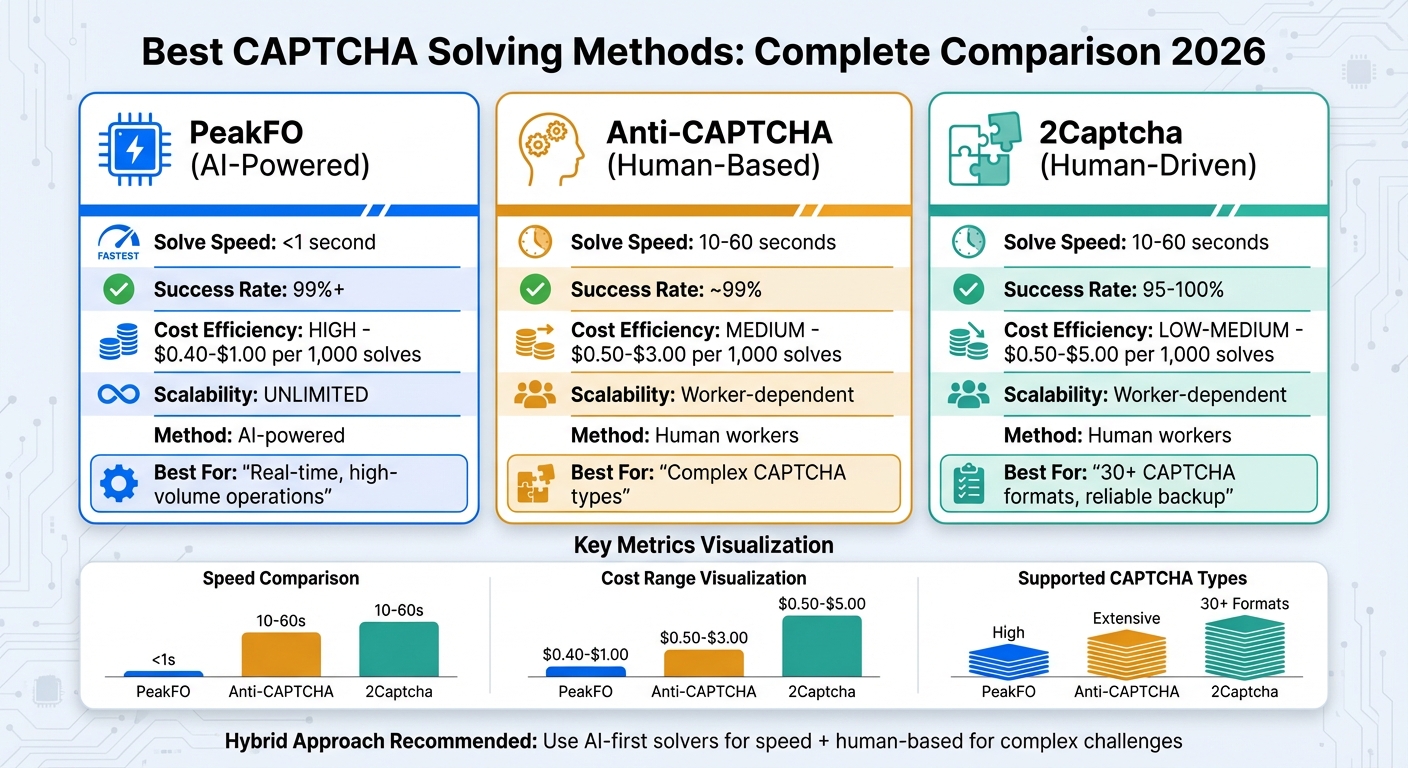
CAPTCHA Solving Services Comparison 2026: Speed, Accuracy, and Cost
TensorFlow Step-by-Step Captcha solving tutorial with custom OCR model
1. PeakFO
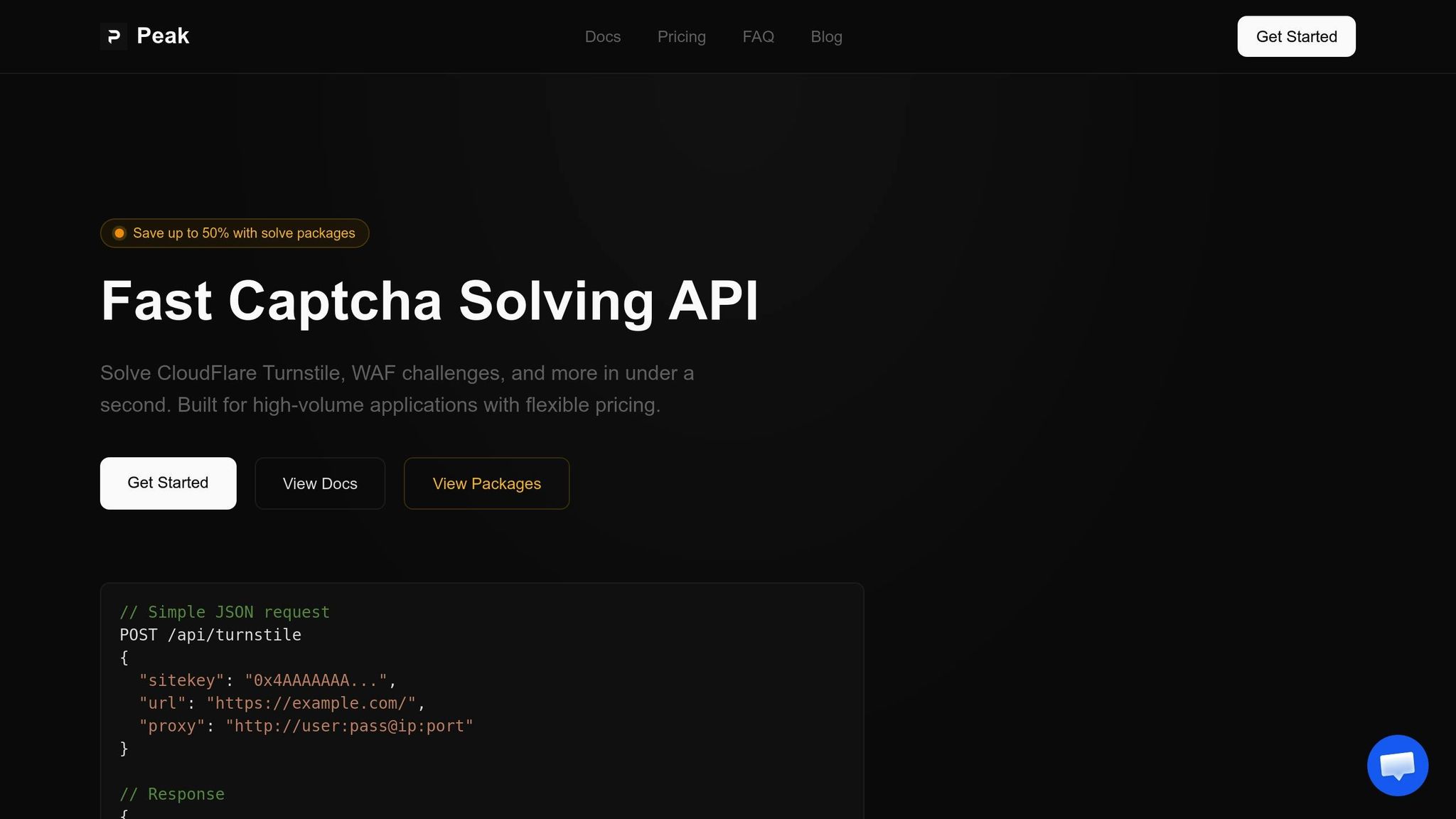
PeakFO is an AI-powered CAPTCHA solver tailored for challenges like Cloudflare Turnstile, Cloudflare WAF, and AWS WAF. It’s built to handle the growing demand for fast and accurate CAPTCHA solving in high-volume scenarios. With response times under one second, it’s designed to keep up with modern operational needs.
Solve Speed
PeakFO stands out with its lightning-fast response times, completing solves in less than one second on average. Even under heavy traffic, it maintains median latencies of 1.5 to 2 seconds. This speed is a game-changer for businesses running time-critical operations, such as flash sales or real-time data extraction, where every second counts.
Success Rate
Thanks to automatic retries and solid error-handling mechanisms, PeakFO boasts a success rate exceeding 99%. Users are only billed for successful solves, meaning failed attempts caused by issues like proxy errors or timeouts come at no extra charge. This reliability ensures operations remain cost-efficient and scalable.
Cost Efficiency
PeakFO offers bulk pricing options that can reduce costs by up to 50% compared to standard rates. For instance:
- A 1 million-solve package for Cloudflare Turnstile costs $0.50 per 1,000 solves.
- AWS WAF mobile SDK challenges are priced as low as $0.40 per 1,000 solves.
For smaller-scale needs, standard pricing starts at $1.00 per 1,000 solves for Cloudflare Turnstile and $0.80 per 1,000 for AWS WAF.
Scalability
PeakFO is built to handle massive workloads, supporting unlimited concurrent requests. This means businesses can process thousands of solves per minute without experiencing rate limits or slowdowns. Whether it’s a high-traffic event or ongoing operations, PeakFO ensures smooth and efficient performance.
2. Anti-CAPTCHA
Anti-CAPTCHA, sometimes referred to as AntiGate, uses a global network of human workers to manually solve CAPTCHA challenges. This approach is especially useful for handling complex or uncommon CAPTCHA types that automated AI systems may find difficult to process.
Solve Speed
Since this service relies on human input, it operates at a slower pace compared to AI-driven solutions. For example, simple text-based CAPTCHAs are usually solved within 5–10 seconds. Modern reCAPTCHA v2 challenges take about 10–25 seconds, while intricate interactive puzzles like FunCaptcha can take up to 60 seconds. During peak times, delays can occur due to high demand, but the human-in-the-loop model ensures a dependable way to address even the toughest CAPTCHA types. While not the fastest option, it excels in accuracy and reliability.
Success Rate
Anti-CAPTCHA boasts an impressive success rate of nearly 99% across all CAPTCHA formats and maintains a consistent uptime of 99.99%. This level of dependability makes it a solid choice for enterprise operations. However, it’s worth noting that the service does not provide refunds for incorrectly solved CAPTCHAs, which could be a concern for users managing large volumes.
Cost Efficiency
Pricing for Anti-CAPTCHA depends on the complexity of the CAPTCHA being solved. Simple image CAPTCHAs cost about $0.50 per 1,000 solves. For reCAPTCHA v2/v3, prices range from $0.95 to $2.00 per 1,000 solves. Similarly, Cloudflare Turnstile and more complex CAPTCHAs like GeeTest and FunCaptcha are priced at around $2.00 per 1,000 solves. The service also uses a floating pricing model, meaning costs can rise during peak hours when worker availability is limited.
Scalability
Anti-CAPTCHA allows for unlimited parallel threads via its JSON-RPC API, making it capable of handling large-scale tasks without formal rate limits. However, since performance depends on the availability of live workers, response times can vary. While the system scales effectively during off-peak hours, fluctuations in worker availability may impact performance during high-demand periods.
3. 2Captcha
2Captcha is a CAPTCHA-solving service powered by human workers, supporting over 30 formats and integrating with more than 4,500 applications. Unlike fully automated tools, 2Captcha relies on real people to tackle complex challenges. With a 99.9% uptime record, it handles a range of CAPTCHA types, including reCAPTCHA (v2, v3, Enterprise), Cloudflare Turnstile, Arkose Labs FunCaptcha, GeeTest, and Amazon AWS Captcha.
Solve Speed
For simple image CAPTCHAs, solve times average between 10–15 seconds. reCAPTCHA v2 typically takes about 13 seconds but can stretch up to 45 seconds for more complex challenges. Tougher puzzles, like Arkose Labs FunCaptcha, may take 30–60 seconds, especially during peak hours when worker availability is lower. While these times are slower than AI-based systems, the trade-off is in reliability. To handle potential delays, it’s a good idea to implement retry logic in your workflow.
Success Rate
2Captcha boasts a success rate of 95–100% across various CAPTCHA types. The service uses a mix of human workers for visual and complex puzzles and AI-driven emulation for behavioral challenges like reCAPTCHA v3. If a CAPTCHA is solved incorrectly, users can report it for a free re-solve or a refund. This dual approach makes 2Captcha a dependable backup when AI-only tools struggle with newer or more intricate CAPTCHA formats.
Cost Efficiency
Pricing varies by CAPTCHA type:
- Simple image CAPTCHAs: $0.50–$1.00 per 1,000 solves
- reCAPTCHA v2/hCAPTCHA: $1.00–$2.99 per 1,000 solves
- Cloudflare Turnstile: around $1.45 per 1,000 solves
- Arkose Labs FunCaptcha: $1.45–$5.00 per 1,000 solves
- reCAPTCHA v3 and Enterprise versions: starting at $2.99, often exceeding $5.00 per 1,000 solves
Though these rates are higher than AI-only solutions, the reliability and accuracy on complex CAPTCHAs often justify the cost for tasks requiring precision.
Scalability
2Captcha is built to handle high-volume demands, solving over 11,000 reCAPTCHA v2 puzzles and up to 12,000 simple image CAPTCHAs per minute. Official SDKs and browser extensions make API integration straightforward. For developers seeking alternative high-speed options, Peak Solutions provides additional tutorials on optimizing API performance. For large-scale operations, maintaining session and IP consistency (using sticky proxies) is essential to avoid token rejection. Enterprise support plans are also available for priority handling and tailored API solutions, making it a solid choice for businesses with significant automation needs. Its ability to scale efficiently underscores its value for critical tasks.
Pros and Cons
Here's a breakdown of the trade-offs between some popular CAPTCHA-solving methods:
PeakFO stands out with its lightning-fast solve times - under a second - and a success rate exceeding 99% on modern challenges like Cloudflare Turnstile and AWS WAF. Its flexible billing structure ensures predictable costs for operations handling high volumes.
Anti-CAPTCHA combines human and AI efforts, making it versatile enough to tackle both common and rare CAPTCHA types. It boasts 99.99% uptime, solve times between 10–25 seconds, and pricing that ranges from $0.50 to $3.00 per 1,000 solves.
2Captcha supports a wide variety of over 30 CAPTCHA formats with nearly 99% accuracy. However, response times vary significantly - from 10 seconds for simpler tasks to up to 60 seconds for complex ones. This makes it a solid fallback option. Pricing ranges from $0.50 to $5.00 per 1,000 solves.
| Method | Solve Speed | Success Rate | Cost Efficiency | Scalability |
|---|---|---|---|---|
| PeakFO | <1 second | 99%+ | High ($30–$700/package) | Unlimited |
| Anti-CAPTCHA | 10–25 seconds | ~99% | Medium ($0.50–$3.00/1k) | Medium (stable under load) |
| 2Captcha | 10–60 seconds | ~99% | Low-Medium ($0.50–$5.00/1k) | Medium (worker-dependent) |
Daniel Shashko from Bright Data highlights, "AI solves are measured in seconds, not minutes. A typical reCAPTCHA v2 solve takes 3 to 9 seconds with Capsolver compared to 20 to 60 seconds with human-powered alternatives".
For automation tasks in 2026 that demand high reliability, many teams lean toward a hybrid approach. They rely on fast, AI-first solvers like PeakFO for the bulk of their workload while integrating human-assisted services to handle the more complex challenges that AI might struggle with. This combination offers a balance between speed and dependability, especially for mission-critical operations.
Conclusion
Choose a CAPTCHA solution that aligns with your automation needs in 2026. For operations requiring high speed and volume, PeakFO stands out with its sub-second solve times, over 99% success rates on advanced challenges like Cloudflare Turnstile and AWS WAF, and seamless scalability. This makes it an ideal choice for handling routine challenges efficiently.
To get the most out of your setup, combine PeakFO’s fast processing with tailored solutions for unique scenarios. This way, you can maintain both speed and reliability without unnecessary expenses.
"For serious automation, solver diversity is a feature, not a weakness." – BitBrowser
Before deploying solvers extensively, focus on anti-bot bypass techniques to reduce CAPTCHA triggers. Using high-quality residential proxies and proper browser fingerprinting can prevent 80–90% of challenges from appearing in the first place. For unavoidable CAPTCHAs - like those during logins or checkouts - specialized solving services become indispensable.
FAQs
How do I integrate PeakFO’s API into my automation stack?
To work with PeakFO’s API, start by obtaining an API key. You can do this by signing up and logging into your account. Next, install the PeakFO Python SDK via pip. Once installed, initialize the client in your script using your API key. From there, you can use specific methods like solve_turnstile() to tackle CAPTCHA challenges and retrieve responses such as tokens or cookies. Don’t forget to programmatically track your balance to keep operations running without interruptions.
What causes CAPTCHA tokens to expire, and how can I prevent failures?
CAPTCHA tokens are designed to expire quickly as a safeguard against replay attacks and to ensure that the verification remains recent. Typically, these tokens are valid for only a short period - often around two minutes.
To minimize errors, it’s crucial to process these tokens immediately after they’re generated. Make sure your automation system is equipped to handle tokens promptly, renew them in real-time if they expire, or, when necessary, re-solve the CAPTCHA challenges. This approach helps maintain smooth and uninterrupted operations.
How can I reduce how often CAPTCHAs appear in my workflows?
To encounter CAPTCHAs less often, it's crucial to address common triggers such as excessive requests in a short time, unusual browsing activity, or an IP address with a bad reputation. Some effective strategies include pacing your request rates, rotating IP addresses, and creating browsing patterns that resemble human behavior.
Modern CAPTCHA systems often analyze browser fingerprints and user activity, so leveraging AI-powered tools can be beneficial. The key is to focus on prevention by making automated actions harder to detect. For situations where CAPTCHAs are unavoidable, advanced solving APIs can step in to manage the challenges efficiently.