
CAPTCHA Solving API: 7 Key Features to Look For
Seven essential features to evaluate CAPTCHA-solving APIs: speed, 99%+ accuracy, advanced CAPTCHA support, unlimited scaling, easy integration, billing, and key tracking.

In 2026, CAPTCHA-solving APIs are essential for businesses relying on automation. Choosing the right API can mean the difference between smooth workflows and costly disruptions. Here are 7 must-have features to look for:
- Sub-Second Solve Times: Fast response (0.2–0.3 seconds) ensures uninterrupted automation, especially for high-pressure tasks like flash sales.
- High Success Rates: Over 99% accuracy minimizes failed attempts, saving API credits and avoiding IP bans.
- Support for Advanced CAPTCHA Types: Compatibility with systems like Cloudflare Turnstile, Cloudflare WAF, and AWS WAF is critical for modern automation.
- Unlimited Scalability: Handle millions of requests daily without performance drops, ensuring reliability during traffic spikes.
- Simple API Integration: Easy-to-use SDKs, standardized protocols, and webhook support simplify setup and maintenance.
- Flexible Billing Options: Choose between pay-per-solve, bulk packages, or subscriptions to match your usage needs.
- Dedicated API Keys & Balance Tracking: Secure access and real-time usage monitoring help prevent disruptions.
These features ensure speed, accuracy, and reliability for automation workflows, even as CAPTCHA systems evolve.
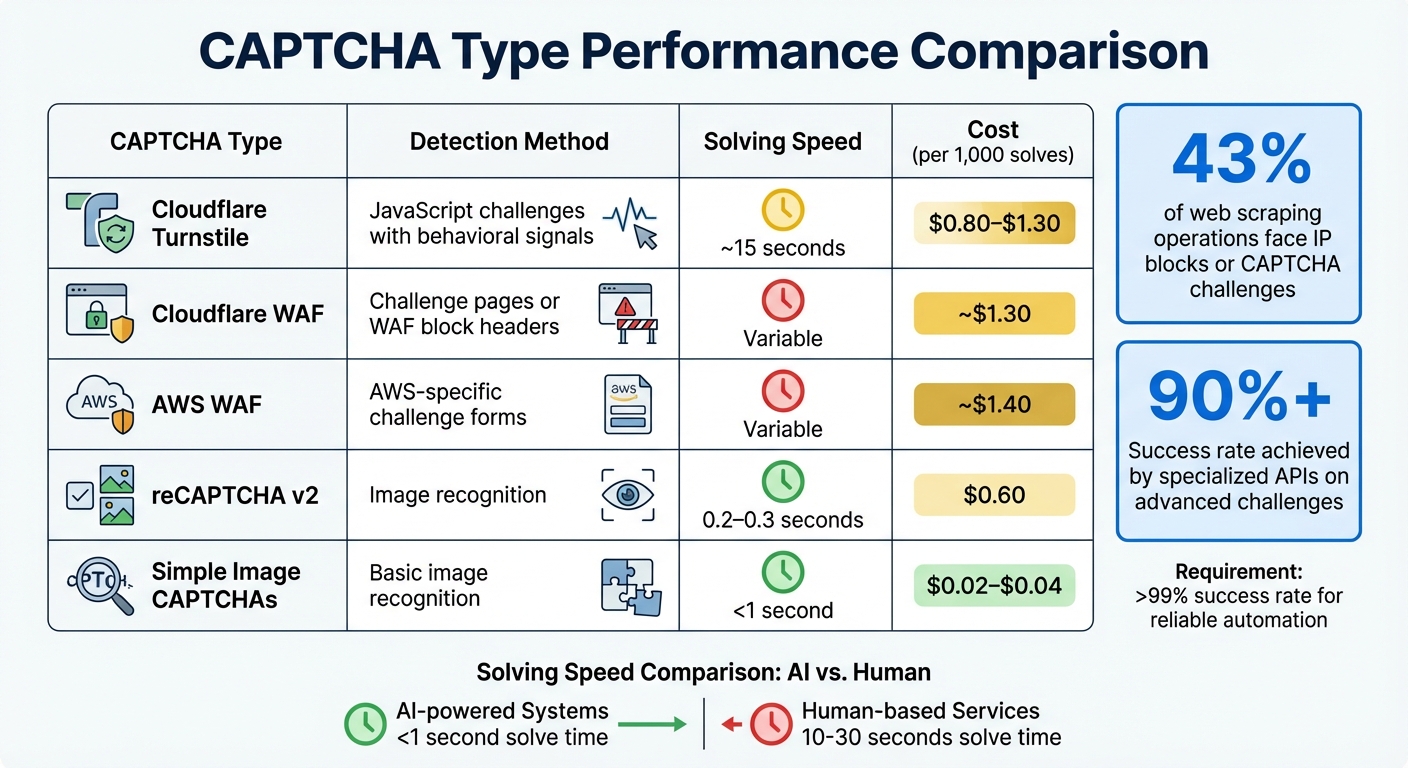
CAPTCHA Solving API Performance Comparison: Speed, Cost, and Success Rates by Type
1. Sub-Second Solve Times
Speed is the backbone of effective automation in 2026. Delays can derail workflows, but efficient solvers handle CAPTCHAs in just 0.2–0.3 seconds, keeping processes smooth and uninterrupted.
In high-pressure scenarios like flash sales or tight data collection windows, even minor delays can slash automation ROI. When you're processing millions of requests, those delays can snowball into massive bottlenecks. That’s why top-tier AI systems deliver consistent performance, even during peak loads.
The gap between solver types is significant. AI-powered systems deliver results in under a second, while human-based services often take 10–30 seconds - far too slow for workflows that demand speed and precision.
"In 2026, sub-second response times are table stakes for most use cases." - AZAPI.ai
For reliability during traffic spikes, AI-driven solvers are the clear choice over human-based options. When evaluating providers, focus on metrics like p95 and p99 latency, which measure the slowest 5% and 1% of solve times, rather than just the average speed. This ensures your system can handle critical moments without faltering.
Fast solve times are the foundation for the reliability discussed in the next section.
2. High Success Rates Above 99%
When it comes to automation, accuracy is everything. A success rate of over 99% ensures workflows run smoothly without interruptions.
Even small failure rates can cause big problems at scale. Imagine a 5% failure rate across 1 million daily requests - that's 50,000 failed attempts. These failures waste API credits, increase proxy expenses, and could even lead to IP bans. And if just 1–2% of data is missed, it might violate SLAs and trigger financial penalties.
But it’s not just about hitting high success rates; precision matters too. The best solvers in 2026 aim for false-positive rates below 0.5–1%. Why? Because trying to solve CAPTCHAs that don’t exist wastes credits and raises red flags with anti-bot systems. Top-tier services maintain around 99% accuracy across major CAPTCHA types. For example, reCAPTCHA v2 solves cost about $0.60 per 1,000 solves, while Cloudflare Turnstile challenges are priced at roughly $1.30 per 1,000 solves.
"A weak solver turns your pipeline into a fragile house of cards; a truly elite one makes automation feel invisible again." - AZAPI.ai
When choosing a provider, don’t just rely on lab-tested numbers. Ask for real-world benchmarks on specific targets like reCAPTCHA Enterprise or Cloudflare Turnstile. For invisible CAPTCHAs, look for an effective success rate of at least 95–98% - this ensures your automation can handle production environments reliably.
High accuracy, paired with sub-second solve times, is the key to dependable and efficient automation.
3. Support for Major CAPTCHA Types like Cloudflare Turnstile, Cloudflare WAF, and AWS WAF
Modern web security relies heavily on advanced and seamless challenges, making tools like Cloudflare Turnstile, Cloudflare WAF, and AWS WAF essential for enterprise-level protection. For uninterrupted automation, a CAPTCHA-solving API must handle these sophisticated systems effectively.
Cloudflare Turnstile, for instance, uses non-interactive JavaScript challenges, combining proof-of-work and behavioral signals to verify users. On the other hand, AWS WAF deploys challenge mechanisms at the infrastructure level when it detects suspicious behavior. Without proper support for these systems, automation pipelines risk breakdowns, wasted resources, and even IP bans. Ensuring compatibility is just as critical as achieving fast solve times and maintaining high accuracy, as previously highlighted.
Here’s a striking statistic: 43% of web scraping operations face IP blocks or CAPTCHA challenges during their workflows. Yet, specialized solving APIs can achieve over 90% success rates, even for such advanced challenges.
| CAPTCHA Type | Detection Method | Solving Speed | Cost (per 1,000) |
|---|---|---|---|
| Cloudflare Turnstile | JavaScript challenges with behavioral signals | Approx. 15 seconds | Approx. $0.80–$1.30 |
| Cloudflare WAF | Challenge pages or WAF block headers | Variable | Approx. $1.30 |
| AWS WAF | AWS-specific challenge forms | Variable | Approx. $1.40 |
For tasks like price tracking, inventory monitoring, or automated testing with tools like Puppeteer or Selenium, ensuring support for these CAPTCHA systems is essential. This compatibility allows for smooth automation and avoids disruptions caused by security challenges.
4. Unlimited Scalability for High-Volume Applications
When automation scales from handling hundreds to millions of daily requests, maintaining smooth operations becomes critical. Human-based CAPTCHA services often hit capacity limits, causing delays during events like flash sales, large-scale data collection, or high-volume onboarding efforts.
AI-powered systems sidestep these limitations entirely. Advanced enterprise-grade APIs can process over 100,000 requests per second while keeping median latency between 1.5–2 seconds. Some top-tier CAPTCHA solvers manage 5–50+ million daily requests, maintaining 99th percentile latency under 8 seconds.
Global auto-scaling infrastructure, including edge clusters and GPU farms, ensures no region becomes a bottleneck. During sudden traffic surges, requests are automatically rerouted to avoid disruptions. For industries like FinTech and insurance, where high-volume claim processing or onboarding is time-sensitive, this distributed setup is essential. It minimizes downtime and helps avoid regulatory SLA breaches or revenue losses during peak loads.
Cost efficiency also improves with scale. While pay-per-solve pricing works for fluctuating traffic, high-volume users often prefer subscription plans or bulk packages. These options provide discounted rates and predictable expenses, making ROI calculations straightforward. Providers typically charge only for successful solves, ensuring cost-effectiveness even at high volumes. This scalable model not only supports performance but also simplifies integration for growing businesses.
5. Simple and Flexible API Integration
After scalability, the next big priority is making integration as smooth as possible. Complicated processes can eat up a lot of developer time, but a well-designed CAPTCHA-solving API simplifies things with tools and protocols that make integration quick and painless.
Many services follow a 2Captcha-style HTTP protocol, which uses straightforward in.php and res.php endpoints. This setup makes it easy for developers to switch providers - just update the base URL and API key. Anthony Heath, a technical reviewer, highlights the advantage:
"Because the 2Captcha-style protocol is almost an industry standard, you can hot-swap providers if one falters - handy insurance for mission-critical flows".
To make things even easier, official SDKs for popular programming languages like Python, JavaScript, Java, PHP, and C# allow developers to integrate with just a single method call. These SDKs, available on platforms like PyPI or npm, eliminate the need to create custom solutions or debug tricky edge cases. For automation tools like Selenium, Puppeteer, and Playwright, pre-built modules provide plug-and-play functionality, saving even more time.
Webhook support is another game-changer. Instead of relying on resource-heavy polling, webhooks notify your server instantly when a CAPTCHA is solved. Additionally, structured JSON-RPC formats help manage more complex settings, such as proxy configurations or browser fingerprints, with ease.
PeakFO's API incorporates these best practices with user-friendly endpoints, detailed documentation, and features like built-in balance tracking. This makes it simple to integrate CAPTCHA-solving into existing workflows, setting the stage for the flexible billing options discussed next.
6. Flexible Billing Options Including Pay-Per-Solve and Bulk Packages
Once you've integrated the service, it’s time to think about payment options. Different usage patterns call for different billing methods, letting you align costs with your actual needs.
Pay-per-solve (pay-as-you-go) works well for smaller or less predictable CAPTCHA volumes. With this model, you’re only charged for successful solves, usually priced per 1,000 units. For example, AI-based services generally charge between $0.02 and $0.04 per 1,000 solves for simple image CAPTCHAs. More complex tasks, like reCAPTCHA v2, can range from $1.00 to $3.00 per 1,000 solves. This option doesn’t require long-term commitments, making it perfect for testing, small-scale projects, or workflows handling around 100 to 500 solves per month. It’s a cost-effective choice for those who need flexibility and want their expenses to reflect actual usage.
Bulk packages, on the other hand, are designed for stable, high-volume operations. If you’re processing hundreds of thousands of solves each month, buying in bulk can significantly lower your per-unit cost. These packages often come with discounts - up to 50% off for challenges like CloudFlare Turnstile or AWS WAF. However, keep in mind that bulk purchases require upfront payment, and any unused quota typically expires within 30 days. Providers like PeakFO even include perks like dedicated API keys and balance tracking to help you manage your usage efficiently.
For those with heavy, consistent needs, subscription models might be the most economical. These plans offer flat monthly rates, which become more cost-effective as your usage increases. For instance, a $24.99 monthly subscription can save money if you’re solving more than 25,000 CAPTCHAs at a rate of $1 per 1,000 solves.
To make the most of these options, calculate your monthly volume, compare it against the available tiers, and pick a model that minimizes wasted spending while meeting your needs.
7. Dedicated API Keys and Balance Tracking
Managing CAPTCHA-solving operations becomes much more efficient with dedicated API keys and real-time balance tracking. These tools ensure smooth performance and secure access, especially for high-volume applications.
Dedicated API keys serve as a secure way to authenticate every request, ensuring only authorized systems can access your service and funds. When you purchase bulk packages through PeakFO, each package comes with its own dedicated API key. This setup makes it easy to track which projects or workflows are using your quota. If you're managing multiple automation pipelines, you can assign unique keys to each project, allowing you to monitor their individual consumption. This approach not only enhances security but also simplifies usage tracking.
Balance tracking is another critical feature that prevents disruptions caused by depleted funds. Most providers include a getBalance API method, which allows you to programmatically check your remaining credits. You can integrate this function into your automation scripts to trigger alerts when your balance drops below a certain threshold. This ensures you can pause operations or top up your account before receiving the dreaded ERROR_ZERO_BALANCE response.
These tools also help manage costs and detect unusual activity. Features like real-time logs, load graphs, and success rate monitoring can reveal unexpected spikes in usage, which might indicate unauthorized access or inefficient code. By integrating dedicated API keys and balance tracking into your workflows, you improve both scalability and reliability.
For users handling thousands of solves daily, these features transform account management into an automated, hassle-free process. Automated balance checks and project-specific keys keep your operations running smoothly in the background, freeing you to focus on other priorities.
Conclusion
Selecting a CAPTCHA-solving API that combines speed, accuracy, scalability, and seamless integration is crucial for your automation needs. By 2026, enterprise-grade performance demands solve rates exceeding 99% and response times under a second. Meeting these benchmarks is critical to maintaining smooth and uninterrupted operations, especially as CAPTCHA challenges continue to evolve.
The landscape has shifted from traditional visual puzzles to more complex behavioral challenges, such as Cloudflare Turnstile and AWS WAF. This evolution has redefined what it means to "solve" a CAPTCHA. APIs now need to replicate genuine human interactions instead of merely recognizing images. Advanced behavioral simulation has become the cornerstone of modern CAPTCHA-solving capabilities, enabling specialized solvers to adapt to these sophisticated detection systems.
When assessing providers, it's essential to test APIs under real-world traffic conditions to ensure they meet the outlined performance metrics. This step helps confirm that the API can handle demanding automation tasks without compromising efficiency or reliability.
Beyond speed and accuracy, practical features like straightforward integration, flexible billing models, and robust API key management are vital for a comprehensive solution. Standardized HTTP APIs and multi-language SDKs streamline integration by isolating solving logic from your core systems. Flexible billing options provide better cost predictability, while tools like dedicated API keys and balance tracking reduce the risk of service interruptions.
"Choosing the Best CAPTCHA Solver API 2026 isn't about picking a 'tool' anymore – it's a strategic decision that directly impacts your uptime, cost per successful request, legal exposure, and overall ROI on automation projects."
– AZAPI.ai
The seven key features discussed throughout this article form the backbone of a dependable and scalable CAPTCHA-solving solution. Look for providers who update their models promptly to address new CAPTCHA variants, maintain 99.99% uptime, and hold compliance certifications like SOC 2 Type II for industries with strict regulations. In the end, the difference between "it mostly works" and "it just works" defines the success of web automation in 2026.
FAQs
Why are sub-second solve times important for automation workflows?
Sub-second solve times play a key role in automation workflows, ensuring smooth operations by cutting down delays and speeding up task completion. Quick solve times are especially critical for maintaining the reliability and efficiency of automated processes, as they help avoid unnecessary interruptions or detection.
In large-scale automation scenarios like data extraction or software testing, even minor delays can accumulate and impact overall performance. Achieving near-instant CAPTCHA solutions allows workflows to scale efficiently without sacrificing speed or functionality.
How do CAPTCHA-solving APIs work with advanced systems like Cloudflare Turnstile?
CAPTCHA-solving APIs tackle advanced systems like Cloudflare Turnstile by using machine learning and behavioral analysis to crack intricate challenges. These tools study patterns and mimic human behavior, allowing the API to navigate complex mechanisms like real-time risk evaluations and behavioral scoring.
By staying updated with the latest CAPTCHA advancements, these APIs offer dependable solutions for automation, ensuring they work seamlessly with even the most sophisticated systems.
Why are flexible billing options essential for CAPTCHA-solving services?
Flexible billing options are an essential feature for CAPTCHA-solving services. They allow users to customize their plans to suit specific needs, whether that's tied to a tight budget, varying usage demands, or operational priorities. This approach ensures users pay only for what they actually use, helping to cut unnecessary expenses and improve cost efficiency.
On top of that, flexible plans make it easier to scale as your needs evolve. Whether you're handling a small-scale project or managing extensive operations, the ability to adjust your plan ensures seamless workflows without stretching your budget.